Punch It by 100HP Gaming: nine steps, four opponents, one withdraw button
A boxing-themed instant win game with no reels in it. Nine stages, four figures guarding each one, and after every successful stage a choice between carrying on and taking what the round is worth so far.

The artwork the game opens with: a boxer, a glove and the chest that sits at the end of the nine stages.
The game
What is Punch It?
Punch It is an instant step-multiplier game built by 100HP Gaming. A round is a walk along nine fixed stages. At the active stage four stickman figures stand in front of you; you throw a punch at one of them, and if the punch lands the tracker above moves on a position and the amount the round is worth goes up. If it does not land, the round is over and the stake is gone.
That is the whole loop, and it is worth saying plainly because the word “instant” covers several unrelated things in a casino lobby. This one is not a scratchcard, where the result is already printed and you only uncover it. It is not a spinning game either, and it is not the kind where a number climbs in real time while you decide when to stop — there is no clock here at all. Each stage waits for you.
The studio is settled. The catalogue entry for the title is filed under 100HP Gaming, the studio publishes its own site, the platform that distributes its games lists it as a provider, and at least one operator carries the title in its lobby under the same name. Our own earlier build of this site names the studio on every page. Nothing we found names a different one.
No reels, no paylines: what replaces them
The screen is an arena rather than a cabinet. A horizontal tracker runs across the top with all nine values written under it in order, so the full path is readable before a stake is placed. Below it, rows of yellow figures recede into the distance; the four largest ones at the front are the stage you are on, and the smaller rows behind are the stages you have not reached.
Instead of symbols there are target markers, punch animations, an oversized red glove and a treasure motif at the far end. The theme does the work that reel symbols would normally do: it tells you where you are without a second screen. A completed stage turns green on the tracker, which doubles as the history of the round you are in.
Because the whole value path is printed in advance, the game gives away its own arithmetic. You can see before staking anything what the ninth stage pays and what the first one pays, which is unusual and genuinely useful — most of what follows on this site is just reading those numbers carefully.
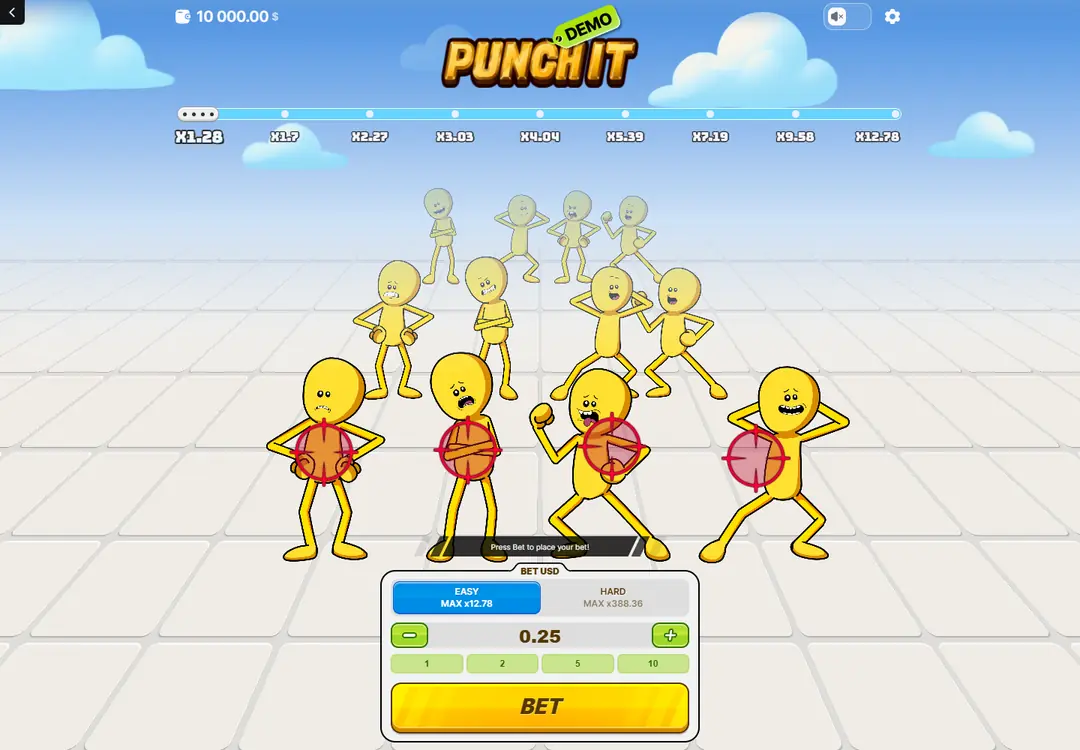
Easy mode. The nine values run along the top before anything is staked, and the four figures in front are the current stage.
Easy against Hard: the full payout breakdown
There are two difficulty settings and they share a board. Both run nine stages with four figures at each, and both open on the same four values — x1.28, x1.70, x2.27 and x3.03. From the fifth stage the paths separate and never meet again.
Easy continues x4.04, x5.39, x7.19, x9.58 and finishes at x12.78. Hard replaces those five with x6.06, x12.13, x24.27, x97.09 and x388.36. The board does not get longer and no extra figures appear: the setting changes the numbers written under the positions, nothing else.
So the ceiling of the game is x388.36 of the stake, reached only by completing all nine Hard stages. The Easy ceiling is x12.78. A catalogue entry for the title rounds the top figure to 388x the bet, which agrees with ours to the decimal place our own source carries.
Return and volatility, as far as either is settled
The figure our source carries is 96%: that is what the game's own information panel listed when this site was first written, and three outside pages about the title repeat it. One operator's page for the same game is headed 95.00% instead. We have found nothing published by the studio itself that settles which build is which.
Printing one of those as the fact would be inventing certainty we do not have, so the honest version is the one on this page: our source says 96%, somebody else's says 95%, and the figure that applies to the round you are about to play is the one in the information panel of the client you are signed in to. Open it and read it there. That takes ten seconds and beats any page written about the game, including this one.
Volatility is thinner still. Our source does not rate it, and the outside pages that do call it average. We are not going to turn somebody else's one-word rating into a specification, so treat it as their description. The published value path tells you more anyway: a game whose ninth step pays x388.36 does not behave like one whose ninth step pays x12.78, whatever label is attached to both.
The decision at the centre of every stage
After a stage is completed the game shows two live controls: carry on into the next stage, or take the figure in the withdraw control and end the round. That is the only decision the player holds, and it is a real one, in the sense that it changes what the session looks like.
What it does not change is the share of a long run the game returns. Stopping early wins small amounts often; pushing to the ninth stage wins a large amount rarely. Those two habits can feel like opposite worlds and still hand back the same proportion of everything staked over time, because the published multipliers are already scaled to do that. A bigger number at a stage has to come with a smaller chance of getting past it, or the number would not be affordable.
This is why there is no system section anywhere on this site. Nothing in the pattern of previous rounds, in which of the four figures you pick, or in how long a losing streak has been running tells you anything about the next punch. Advice to “cash out at stage five” is a preference, not an edge, and anyone selling it as an edge is selling the arithmetic back to you with a markup.
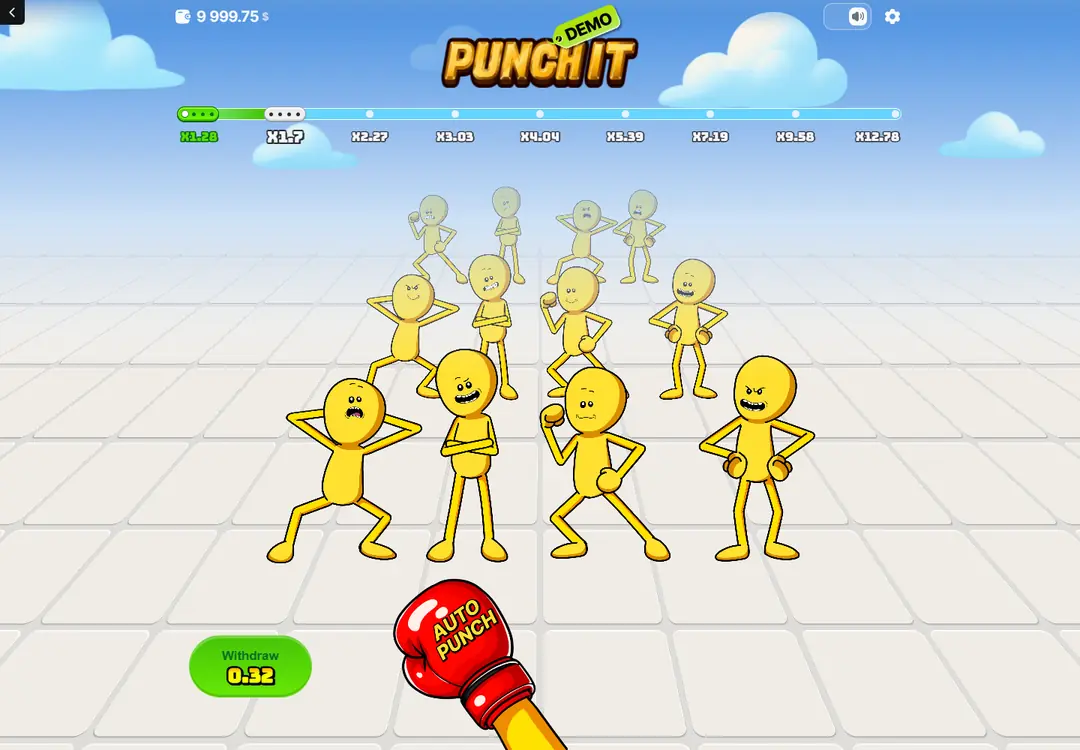
One stage completed. The finished segment turns green, the next group moves forward, and the withdraw control picks up a figure.
Where the free-play version stands
Free play is worth a straight answer because the pages about this title disagree with each other. A large catalogue publishes a page for the game headed as a free-play page and then states on it that the demo is not available there. One operator's own game page says flatly that the title has no demo mode. Another operator advertises free play on it.
The sensible reading is that the engine supports a no-stakes mode and whether you get one depends on the operator and the territory you load it from. That is normal for instant titles and it is why a flat “yes, there is a demo” would be wrong as often as it was right.
There is no demo on this site, and there never will be: we hold no balance, run no game client and will not link to a copy of the client that is not the operator's own. If free play matters to you, look for a “play for fun” toggle on the game tile in the lobby before you deposit, not after.
Playing from Britain: age, money and the lines that answer
This site is written for readers in Great Britain, where every form of commercial gambling is 18 and over. The button at the top of each page asks before it opens anything, and the answer is kept in your own browser rather than sent anywhere.
The stake range our source records runs from 0.10 to 150 a round. That is a wide span, and on a game where a round can end on the first punch the low end of it is the useful end. Nine stages resolve in seconds, which packs far more completed rounds into an evening than a table game would — worth knowing before the automatic target selection shortens them further.
If it has stopped being a game, the national line the regulator points to answers at any hour, and the number is different in Wales. Both are in the footer of every page here, with the self-exclusion scheme that covers every licensed British site at once.
Questions readers ask first
- Who created Punch It?
- 100HP Gaming. The studio is named by its own site, by the catalogue entry filed under it, by the platform that distributes its games and by an operator lobby carrying the title.
- What type of game is it?
- An instant step-multiplier game: nine fixed stages, four opponents at the active stage, and a withdraw control that appears once a stage has been completed. No reels and no paylines.
- What is the return figure?
- Our source records 96% from the game's information panel, and one operator's page for the same title is headed 95%. Read the panel inside the client you are signed in to.
- How high can a round go?
- x12.78 of the stake on Easy and x388.36 on Hard, in both cases only by completing all nine stages of that setting.
- Is there a way to improve the odds?
- No. Which of the four figures you pick, and how the previous rounds went, tell you nothing about the next punch. Choosing when to stop changes the shape of a session, not what it returns.
- Can it be played without staking money?
- Sometimes, depending on the operator: some lobbies offer a no-stakes mode on this title and at least one states that it has none. There is no playable copy on this site.
Everything above is a description of a product, not an offer. No bonus, wagering term, payment method, limit or licence number appears anywhere on this site, because nothing we hold confirms one.
Related pages
A round · Easy · Hard · Multipliers · On a phone · Game info